
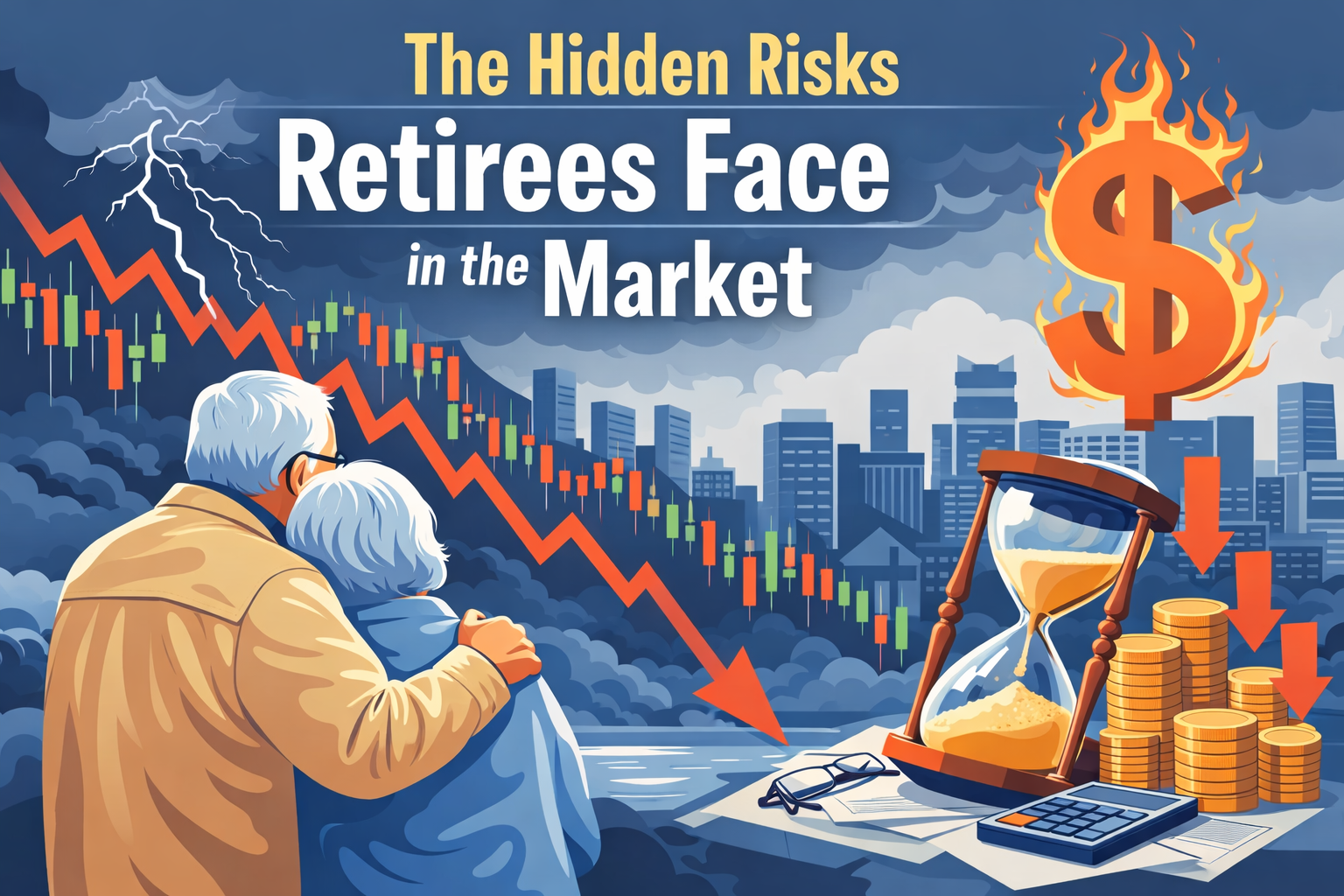
The Hidden Risks Retirees Face in the Market
Most people assume the biggest danger in retirement is a market crash.
It isn’t.
The real issue is that retirement changes the math. Once you shift from accumulating assets to depending on them for income, the entire risk structure of your portfolio changes. What used to be volatility now becomes a threat to sustainability. What used to be a temporary decline can become permanent impairment.
That’s why understanding retirement investment risks is not optional. It’s foundational.
And more importantly, it’s why the market risks retirees face are often hidden in plain sight.
Risk Looks Different After 60
During your working years, market declines are inconvenient. During retirement, they are structural.
If you’re still earning a paycheck, you can wait out downturns. Contributions continue. Time is on your side. In retirement, withdrawals begin. The direction of cash flow reverses. Now the portfolio must support you.
This is where one of the most misunderstood retirement investment risks comes into play: sequence-of-returns risk.
If you experience losses early in retirement while simultaneously withdrawing income, the portfolio may never fully recover—even if average returns over time look acceptable. We break this down in detail in our article on Sequence of Returns Risk, which explains how timing—not just performance—can determine long-term outcomes.
This is one of the core market risks retirees face, and it rarely receives enough attention in traditional planning conversations.
Volatility Is No Longer Just “Noise”
In accumulation mode, volatility is background noise. In retirement, volatility becomes cash-flow pressure.
Let’s say you’re drawing 4–5% annually. A 20% market decline does more than reduce your balance. It forces withdrawals from depressed assets, shrinking future compounding potential. This compounds damage.
Our deep dive on Market Volatility and Retirement Income explores how even normal market swings can disrupt income sustainability when portfolios aren’t structured correctly.
Volatility itself is not the enemy. Unmanaged volatility while withdrawing income is.
And that distinction defines many retirement investment risks.
Selling Assets Is Not Neutral
There’s a popular assumption that you can simply “sell a little each year” to generate income. In theory, this sounds reasonable.
In practice, selling assets in retirement introduces a hidden fragility.
Every sale reduces principal. Every sale during a downturn locks in losses. Every sale shrinks the future income-producing base of the portfolio.
We address this directly in Why Selling Assets for Income Can Undermine Long-Term Security, because the risks of selling investments for retirement income are often understated. Selling is not merely a transaction. It’s a structural decision that impacts long-term sustainability.
This is one of the most overlooked market risks retirees face: liquidation risk.
Inflation Quietly Erodes Stability
Inflation doesn’t need to spike dramatically to create problems. Even modest inflation over a 20- to 30-year retirement erodes purchasing power significantly.
A portfolio that looks stable on paper may be losing real value in terms of income capacity.
This is why retirement investment risks include not only volatility and sequence, but purchasing power risk. Income that fails to grow is income that slowly declines in real terms.
For broader economic context on inflation and long-term purchasing power trends, the Federal Reserve provides educational resources that are worth reviewing at the Federal Reserve’s website. Historical inflation data can also be explored through the U.S. Bureau of Labor Statistics, which tracks CPI trends.
External awareness helps frame internal strategy.
Psychological Risk Is Real
Another of the hidden market risks retirees face is behavioral.
Fear increases when income depends on the portfolio. Retirees may become overly conservative after losses, locking in poor long-term positioning. Others may chase yield in riskier securities in search of higher income.
Both reactions can undermine stability.
Understanding retail vs. institutional psychology, and developing a disciplined income-focused framework, reduces emotional decision-making. That’s why we emphasize structure over prediction.
The Portfolio Value Illusion
Many retirees still measure success by account balance.
But retirement is not about net worth alone. It’s about durable income.
This is where the distinction explored in How Retirement Income Is Different from Retirement Wealth becomes critical. A high portfolio value does not automatically translate into stable, usable income.
Cash flow changes everything.
If income is inconsistent, the portfolio becomes a source of stress rather than security.
The Structural Shift Most Investors Miss
The biggest transition in retirement is not age. It’s function.
Your portfolio shifts from growth engine to income system.
If you continue using accumulation-era strategies without adapting structure, retirement investment risks increase significantly. This is why our cornerstone guide, Simple Income Investing: A Practical Guide to Building Reliable Retirement Income, reframes retirement around income durability rather than maximum appreciation.
Once you see retirement through an income lens, the market risks retirees face become easier to manage. They don’t disappear—but they become identifiable and controllable.
Managing Risk Through Structure
The goal is not to eliminate risk. That’s impossible.
The goal is to align:
Income generation
Withdrawal strategy
Volatility tolerance
Portfolio design
When those components are aligned, sequence risk declines. Forced selling decreases. Emotional reactions soften. Inflation planning improves.
Retirement becomes more stable.
When they are not aligned, retirement investment risks compound quietly beneath the surface.
Final Thought
The greatest market risks retirees face are rarely dramatic. They are structural.
Sequence of returns risk.
Volatility under withdrawal pressure.
Selling assets during downturns.
Inflation erosion.
Behavioral overreactions.
None of these are sensational. All of them are consequential.
Retirement security is not built on optimism about markets. It is built on thoughtful design.
When portfolios are structured for income first and growth second, retirement investment risks become manageable rather than destabilizing.